No Hype, Just Standards · Short breakdown
This is boring but it’ll skyrocket your testosterone fast
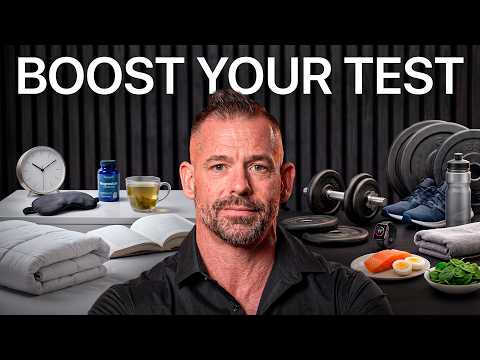
What this episode says
- The call goes the same way every week: a sharp, successful man who has already decided his testosterone is low and wants to know what to take. When the panel is run, the number is not the start of the story; it is the readout of a body that has not slept, carries too much fat, trains wrong, and runs on stress and alcohol.
- Sleep first, because it is the fastest win. A University of Chicago study cut healthy young men to five hours a night for one week and their daytime testosterone fell 10 to 15 percent, about what aging ten to fifteen years does. You do not have a low testosterone problem; you have a five-hours-of-sleep problem wearing a low-testosterone costume.
- Body fat is hormonally active tissue running the enzyme aromatase, which converts testosterone into estrogen and disrupts the brain's signal to make more. It runs in reverse: lose meaningful fat and total and free testosterone tend to climb.
- The training that supports hormones is resistance training with compound loaded movements: squats, deadlifts, presses, rows. Hours of daily grinding endurance work can push testosterone the other way. A man who lifts three or four times a week and walks is in better hormonal position than one pounding 90 minutes of cardio a day.
- Then subtraction. Heavy regular drinking lowers testosterone across the whole chain and ramps up aromatase; cut it back and numbers recover over weeks to a couple of months. Chronic stress keeps cortisol up, and cortisol works against testosterone; it is the thread through all of it.
- Sometimes a man does all of it, gives it months, and is still genuinely low from a real medical cause. That is the moment for real bloodwork with a real doctor, not a video, and not whoever is pitching hardest online.
You do not have a low testosterone problem. You have a five-hours-of-sleep problem wearing a low-testosterone costume.
The disappointing answer
Zac opens by promising disappointment. There is no secret compound and no one weird lever. He runs full hormonal panels on high-performing men over 40 for a living, and the man who is tired at 45, soft in the middle, with no drive and no edge, almost never has an exotic problem. He has a foundation problem, and he has been so busy hunting for the shortcut that he never built the base that would have fixed it months ago.
How the call goes
Every week a successful, sharp man who runs a company books a call, and the first thing he says is some version of I think my testosterone is low, what do I need to take. He has read the thread, seen the ad, and is halfway to ordering from a clinic website. He wants the lever, because that is how he runs everything else: find the high-leverage move, deploy capital, win. He treats his body like a deal he can close with the right purchase. When the panel is run, the testosterone number is not the start of the story. It is the readout of a body that has not slept right in years, carries more fat than it should, trains in a way that does almost nothing for it, and runs on stress and alcohol. The number is low because the inputs are broken, and you cannot buy your way past a broken input. The foundation comes first, not because it is the polite answer but because it works, and faster than the thing he was about to buy.
Sleep
The one almost everyone gets wrong, and the one Zac fights executives on hardest, because a culture taught them that needing sleep is weakness. The straight science: a University of Chicago study cut healthy young men to five hours a night for one week. Daytime testosterone dropped 10 to 15 percent, which the researchers compared to aging ten to fifteen years. One week. You do not have a low testosterone problem; you have a five-hours-of-sleep problem wearing a low-testosterone costume, and you have been hunting for a bottle to fix a hole you dig every night on purpose. It is also the fastest win, which is why it leads: you cannot add ten years of training age this week, but you can sleep tonight and again tomorrow and feel it inside two weeks.
The fat
The uncomfortable one. The extra fat a man carries is lowering his testosterone right now, because body fat is hormonally active tissue running the enzyme aromatase, which converts testosterone into estrogen and throws off the brain’s signal to make more. The hopeful half is that it runs in reverse: lose meaningful fat and total and free testosterone tend to climb, because the machinery converting it away is being removed. Sleep and fat stack. Fix both and two of the biggest drags are gone before anything is taken.
Training
The man who decides to get healthy usually buys the bike, starts running, and grinds an hour on the treadmill feeling virtuous. For the heart, fine. For testosterone and body composition it is the slowest lane, and past a point it works against him; chronic grinding endurance work can push testosterone the other way. What supports hormones is resistance training with compound loaded movements, squats, deadlifts, presses, rows, the kind that puts weight on a bar, drives a hormonal response, and builds the muscle that pulls fat off and shuts down the aromatase problem. A man who lifts hard three or four times a week and walks is in better hormonal position than one pounding 90 minutes of cardio a day wondering why he is flat. Lift heavy, build muscle, walk, and stop confusing exhaustion with progress.
Subtraction
Everything above is building something. The last part is removing something, which is harder because it is easier to add a supplement than give up a habit. Alcohol first, because the executive crowd has a blind spot the size of a wine cellar. Heavy regular drinking lowers testosterone across the whole chain, the brain’s signal, the body’s production, and it ramps up the same aromatase. Not a call to become a monk; the four-drinks-every-night pattern is taxing a man in a way he would be furious about if a clinic did it to him, and for most men, cutting back recovers the numbers over weeks to a couple of months. Then chronic stress, which keeps cortisol elevated, and cortisol works against testosterone. It is the thread through the whole episode: poor sleep raises it, grinding cardio raises it, the all-gas-no-brakes life raises it. The foundation is one system. Remove what suppresses it and it recovers on its own.
The truth about fast
The number can move fast. The speed comes from the suppressors removed and the foundation finally built: sleep like it matters, own a body that stops converting its own testosterone away, lift heavy instead of grinding flat, pull back on the alcohol and the chronic stress. Give it an honest run and most men over 40 feel like a different man in weeks, because they finally stopped ignoring the obvious lever. For most men the boring things are not the warm-up for the real protocol. They are the protocol. Free, controllable, and the part they have been skipping while hunting for something to buy.
And the other side, honestly: sometimes a man has the foundation right, gives it months, and is still genuinely low from a real medical cause. That is when he gets actual bloodwork with a real doctor, not a video, Zac’s included, and not whatever is pitched hardest online. Zac is a coach, not a physician, and will not tell anyone what to put in his body; that is a decision for the man and a licensed provider with real data. In Executive Health Edge, that decision goes to the program physician by written handoff. The companion episode covers what testosterone replacement actually is, what is real, what is hype, and who needs it.
Transcript
Full text, timestamped
Auto-generated from the episode audio and lightly formatted. Each timestamp links to that moment in the video.
0:00 I want to tell you how to raise your testosterone, and you’re going to be absolutely disappointed cuz it’s boring. There’s not a secret compound. There’s not this one weird lever you pull. If that’s what you came for, there’s the door right there. I run full hormonal panels on high-performing men over 40 for a living. So, I’ll tell you what I see. The guy who’s tired at 45, soft in the middle, no drive, no edge. He doesn’t have an exotic problem. He has a foundation problem. And he’s been so busy hunting for the shortcut that he’s never built the base that would have fixed it months ago. So, that’s the deal I’m going to make with you. I’m not selling you anything to swallow. I’m going to walk [music] you through the four boring inputs that would actually move your testosterone. The ones that you can control, and I’m going to be straight that the reason they work so fast is because you’ve been ignoring them for so long. So, let’s get into it. Let me tell you exactly how this goes because I watch it every week. A guy books a call with me. He’s successful, sharp, runs a company, or at a desk that prints money. And the first thing out of his mouth is some version of, “I think my testosterone’s low. What do I need to take?” He’s already decided. He’s read the thread. He’s seen the ad. He’s halfway to ordering something off a
1:00 Clinic website. He wants the input. He wants the lever. And I get it because that’s how he runs everything else. Finds the high-leverage moves, deploys capital, win. So, he treats his own body like a deal he can close with the right purchase. Here’s where this all falls apart. When I actually run his panel, the testosterone number is really the start of the story. It’s the end of it. It’s the readout of a body that hasn’t slept right in years. Carries more fat than it should. Trains in a way that does almost nothing for it. And runs on stress and alcohol. The number is low because the inputs are broken. And you cannot buy your way past a broken input. You can only fix it. So, before you spend a dollar on anything, understand the order of operations. The foundation comes first. Not because it’s the safe, polite answer, because it’s the one that actually works. [music] And it works faster than buying the thing you were about to buy. Start with sleep because it’s the one almost everyone here is getting wrong. Sleep is the one thing I have to fight executives on the hardest because a whole culture taught them that needing sleep is weakness. Five hours in a war face. Run while they rest. You’ve heard it, maybe you’ve said it. So, let
2:00 Me give it to you as the straight science. There’s a study out of the University of Chicago where they took a healthy young men and cut them to five hours of sleep at night for one week. Just one week. Their daytime testosterone dropped by 10 to 15%. The researchers put it bluntly, that drop is about what you’d expect from aging 10 to 15 years. One week of bad sleep aged these men’s hormones by a decade. Sit with that. Because it refrains the whole thing. You don’t have a low testosterone problem, you have a five hours of sleep problem wearing a low testosterone costume. And you’ve been hunting for a bottle to fix the hole you’ve dug yourself every single night on purpose. This is also the fastest win on the list, which is why I led with it. You can’t add 10 years of training age to your body this week. You can absolutely give it a real night’s sleep tonight, and again tomorrow, [music] and feel the difference inside of a couple of weeks. That’s the pattern for everything in this video. The boring input you’ve ignored the longest is the one that pays back the fastest. Now the uncomfortable one, the fat you are carrying. And this is the one guys are going to get defensive about. So, I’ll
3:00 Just say it straight. The extra fat you’re carrying is working against you. It’s lowering your testosterone right now. And there’s a real biological reason. Body fat isn’t an inert storage tank, it’s a hormonal active tissue. And it runs on an enzyme called aromatase. Aromatase takes your testosterone and converts it into estrogen. So, more excess fat you carry, the more your own testosterone gets turned into the wrong hormone. And the more that throws off the signal your brain uses to make more. The fact is, in a real measurable way, working against you. Now the part that should give you hope because I’m not here to make you feel bad about your gut. This runs in reverse. When men lose meaningful body fat, their testosterone tends to climb, total and free, because there’s less tissue converting it away. You’re not just looking better, you’re literally removing the machinery that was suppressing you. So, put the first two together because they stack. Fix the sleep, lose the fat, and you remove two of the biggest things dragging your number down before you’ve taken anything at all. That’s most of the fight. But, how you train decides whether your fat comes off or your body composition changes. And most men over 40 train in
4:01 The exact wrong way for that. That’s next. If this is the first time someone’s told you the boring stuff is the answer instead of selling you the shortcut, stay with me. Because the back half is where this gets real. How you train, and the two things you do every week that are taxing your testosterone while you blame everything else. These are the ones that cost you something to give up. So, you decided to get healthy. What did you do? You did more cardio. You bought the bike. You started running. You grind an hour out on the treadmill and feel virtuous about it. And for your heart, fine. Good. But, if your goal is your testosterone and your body composition, you picked the slowest lane there is. And past the point, you’re working against yourself. So, let me give you the honest version. The training that supports your hormones and changes your body is resistance training. Compound movements that load real muscle. Squats, deadlifts, presses, rows. The stuff that makes you put weight on a bar. That kind of training drives a real hormonal response and builds the muscle that fixes your body composition. Which, remember, is the thing that pulls fat off and shuts down the aromatase problem we covered a
5:03 Minute ago. It’s the same fight from a different angle. And the flip side is the part that the cardio crowd doesn’t want to hear. Chronic grinding endurance work, hours of it, day after day, elevated and could push the other way on your testosterone. More is not better. A man who lifts hard three to four times a week and walks is in better hormonal position than a man pounding out 90 minutes of cardio every day and wondering why he’s flat and stuck. Lift heavy, build muscle, walk, and stop confusing exhaustion with progress. Three boring inputs down, sleep, fat, training, and they’re all things you can control without a prescription. Everything so far has been about building something. This last one is about removing something, and that’s the hard one because it’s easier to add a supplement than give up a habit you already have. Start with alcohol because the executive crowd has a blind spot the size of a wine cellar here. The science is consistent. Heavy, regular drinking lowers testosterone in men. Then hits the whole chain. The signal from your brain, the production in your body, and it ramps up in the same aromatase that turns your testosterone into estrogen.
6:03 I’m not going to tell you to become a monk, but the four drinks a night every night is how I own wine pattern is taxing you in a way you’d be furious about if a clinic was doing it to you. And the good news matches the rest of the video. For most men, cut it back and the numbers recover over a matter of weeks to a couple of months. Then stress, the real one, the chronic kind. When you live in a permanent state of pressure, your body keeps your stress hormone cortisol jacked up. And cortisol works against testosterone. This is an executive’s actual occupational hazard. And notice how it ties the whole video together. Poor sleep raises it. Grinding yourself into the ground with cardio raises it. The all gas, no brakes life raises it. The foundation is one system. And the stress is the thread running through all of it. So that’s the subtraction. Remove what is suppressing you and the system recovers on its own. Put all five together and the real answer to this whole topic becomes into focus. And it’s the opposite of what you were sold. So let me put it all together and let me be blunt about it. You came here wanting your testosterone to skyrocket fast. And guess what? It can. The speed though comes from the
7:05 Suppressors you remove and the foundation you finally build. I want you to sleep like it matters. I want you to own body so it stops converting your own testosterone away. I want you to lift heavy instead of grinding yourself flat with cardio. Pull back on the alcohol a little bit and the chronic stress that has been taxing yourself for years. Do those. Give it a real and honest run. And most men over 40, you’re going to feel like a different man in a matter of weeks because you have finally stopped ignoring the obvious lever. And this is the part that should land the hardest for you. Those boring things are the warm-up for the real protocol. For most men, it is the protocol. It’s free. It’s yours. It’s your control. And it’s the part you’ve been skipping while you’ve hunted for something to buy. I run your blood work for a living, so I’ll be honest about the other side, too. Sometimes a man does have the foundation right, gives it months, and his numbers are still genuinely low from a real medical cause. That’s real, and that’s exactly when you get actual blood work with a real doctor, not a YouTube video, mine included, and not whatever’s being pitched the hardest online. I’m a coach, I’m not your physician, and I’m not going to sit here and tell you what to put in your body because that’s a
8:05 Decision you and a licensed provider should look at with actual data. That’s the truth about raising your testosterone fast. It’s boring, but it’s free. It’s the foundation you already knew about and kept putting off. Build that first, and most of what you were about to go buy, you’ll never need. So, you don’t start with a prescription, and you don’t start with a bottle. You start with a foundation because that’s the part that’s yours. And for a lot of guys, it’s the part that changes how you feel the fastest. Now, the question I didn’t touch, here’s the other side of it. What if you do all of this, you do it all right, and your numbers are still low? That’s the medical conversation, the one about testosterone replacement. What’s real, what’s hype, and who actually needs it. I made a whole video breaking down the honest version of that. No fear-mongering, no sales pitch. If that’s the question you’re left with, that’s the next one to watch. I’ll see you over there.