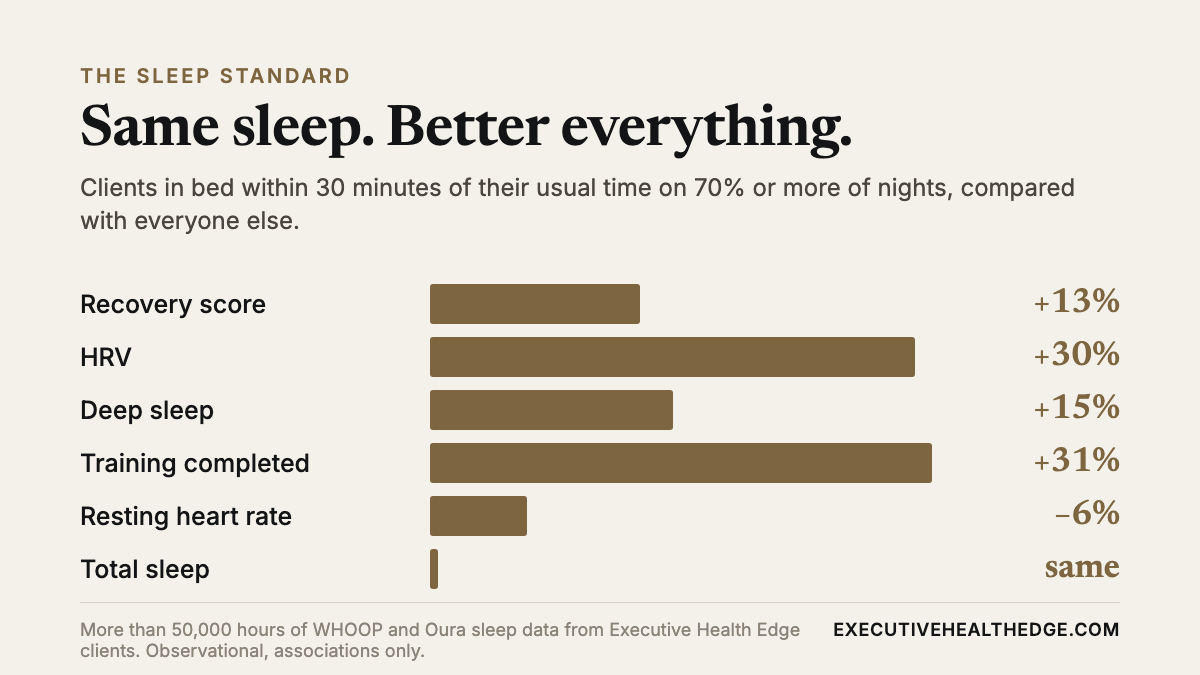
In more than 50,000 hours of WHOOP and Oura sleep data from our clients, those who were on time on 70% or more of nights had recovery scores 13% higher, HRV about 30% higher and resting heart rates 6% lower than everyone else, and completed about a third more of their training. They did not sleep more: total sleep was within 1%. The clock carried the effect.
One standard, not a sleep-hygiene list
Most sleep advice for executives is a list: cold room, no screens, magnesium, blackout curtains. Our clients have read the list. What they do not have is a standard, a number they are held to and checked against the next morning. So we give them one: a bedtime, set in advance, in bed within 30 minutes of it at least five nights out of seven.
We coach it that way because of what the data says.
What more than 50,000 hours show
Every client in the program wears a WHOOP or Oura that syncs to our platform daily. We read that data for coaching decisions every morning, and we periodically pull it together to see what the whole client base is telling us. The current read covers more than 50,000 hours of sleep from clients ranging in age from their 30s to their 70s.
The first thing it shows is that these men do not sleep enough. The median client averages about 6 hours 45 minutes. Most average under 7 hours. Roughly one night in four is under 6. Weekends run about 25 minutes longer and the wake-up is nearly an hour later, which means the weekday schedule, not the bed, is the constraint.
The second thing is the one that changed how we coach. We defined on time as in bed within 30 minutes of a client’s own usual bedtime, either side. Clients who were on time on 70% or more of their nights, compared with everyone else:
- Recovery score 13% higher
- HRV about 30% higher
- Resting heart rate 6% lower
- 15% more deep sleep
- About a third more of their scheduled training completed
- Total sleep: the same, within 1%
They did not sleep more. They slept on schedule. Below 70%, most of the advantage disappeared: on resting heart rate and recovery, a client on time half the time looked about the same as one who was rarely on time.
What the research says
Our data is observational, so we checked it against published research. It points the same way.
- Regularity predicts more than duration. In more than 60,000 UK Biobank adults tracked with wrist sensors, the most regular sleepers had a 20 to 48% lower risk of death from any cause than the least regular, and regularity was the stronger predictor (Windred et al., SLEEP, 2024).
- Assigned regular bedtimes moved the same markers. In a randomized crossover study, 12 nights of regular sleep timing with similar total sleep lowered resting heart rate from 65 to 62 and raised HRV from 34 to 42 ms (Gonzales and Narvaez, Sleep Medicine, 2025).
- Irregular timing tracks with metabolic risk. Each hour of night-to-night variation in sleep timing went with 23% higher odds of metabolic syndrome, independent of total sleep (Huang and Redline, Diabetes Care, 2019).
- Resting heart rate matters in men like our clients. In 2,798 employed middle-aged men followed for 16 years, mortality risk rose 16% per 10 beats per minute of resting heart rate, independent of fitness (Jensen et al., Heart, 2013).
- Short nights impair you without your noticing. Two weeks of six-hour nights produced thinking deficits equal to up to two nights of total sleep loss, and participants were largely unaware of it (Van Dongen et al., SLEEP, 2003).
- A leader’s bad night reaches his team. In 88 supervisors over 10 workdays, poor sleep quality led to more abusive behavior the next day and lower team engagement; hours slept did not (Barnes et al., Academy of Management Journal, 2015).
On our podcast, psychologist Dr. Stephen Sideroff explains the mechanism behind the HRV numbers: chronic stress keeps the fight-or-flight response switched on, and falling asleep requires coming down from that activation (No Hype, Just Standards, 19:10).
Same man, different night
Averages across a group can hide a lot, so we also measured each client against himself. On nights he went to bed more than an hour later than usual, his next-morning recovery score ran about 12% lower than on his on-time nights, his HRV about 4% lower and his resting heart rate about 2% higher. More than 8 in 10 clients showed the lower recovery. More than ninety minutes late, the recovery gap grew to about 14%.
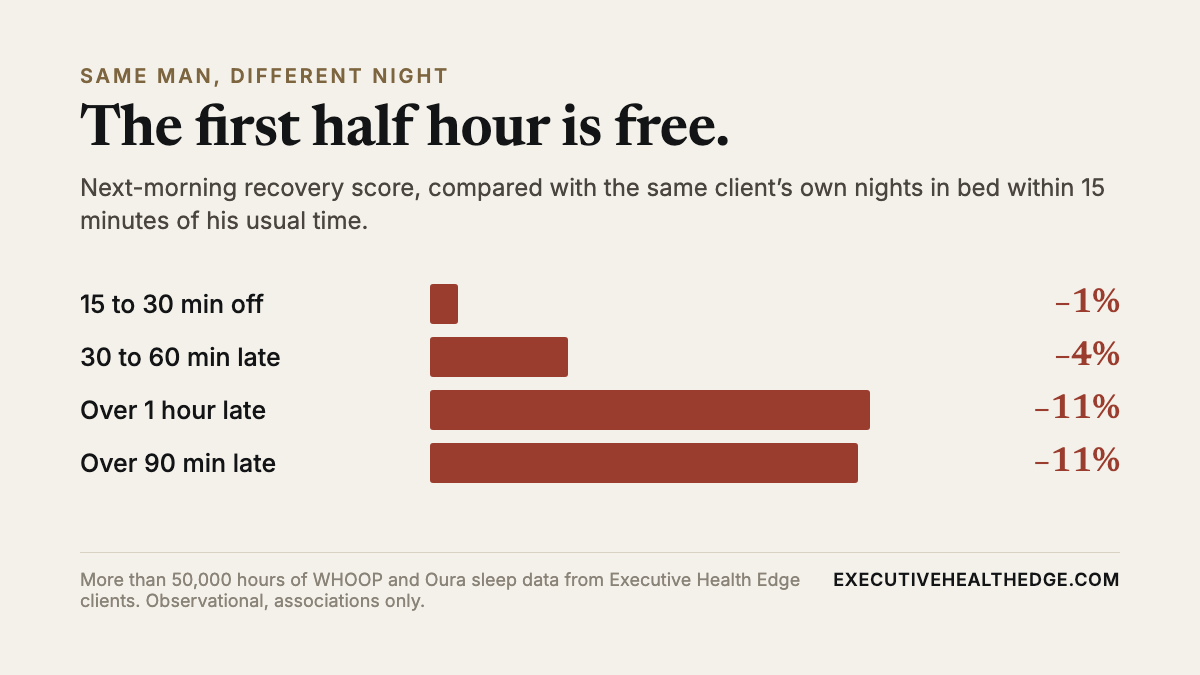
We also tested a tighter 15-minute window. It showed no measurable extra return: nights 15 to 30 minutes off a client’s usual time looked the same the next morning as nights inside 15 minutes. The first half hour is free. We still coach a 15-minute target, because aiming for 15 is how a client lands inside the hour.
Alcohol and the late night
Clients log alcohol in their food diaries, and they under-log it: in the one week we could check, the logs caught about a third of what was drunk. Even so, the pattern is clear. Against a client’s own dry, on-time nights:
- One or two drinks, in bed on time: resting heart rate essentially unchanged, recovery about 8% lower.
- One or two drinks, in bed more than an hour late: resting heart rate about 8% higher, recovery about 19% lower.
- Three or more drinks, even on time: resting heart rate about 10% higher, HRV about 22% lower, recovery about a third lower.
A drink alone and a late night alone each cost about 11% of the next morning’s recovery. Together, about 20%. Drink nights also started later than dry ones. Published research agrees on direction: in more than 4,000 working adults, overnight HRV-based recovery fell at every level of drinking, even low doses (Pietilä et al., JMIR Mental Health, 2018).
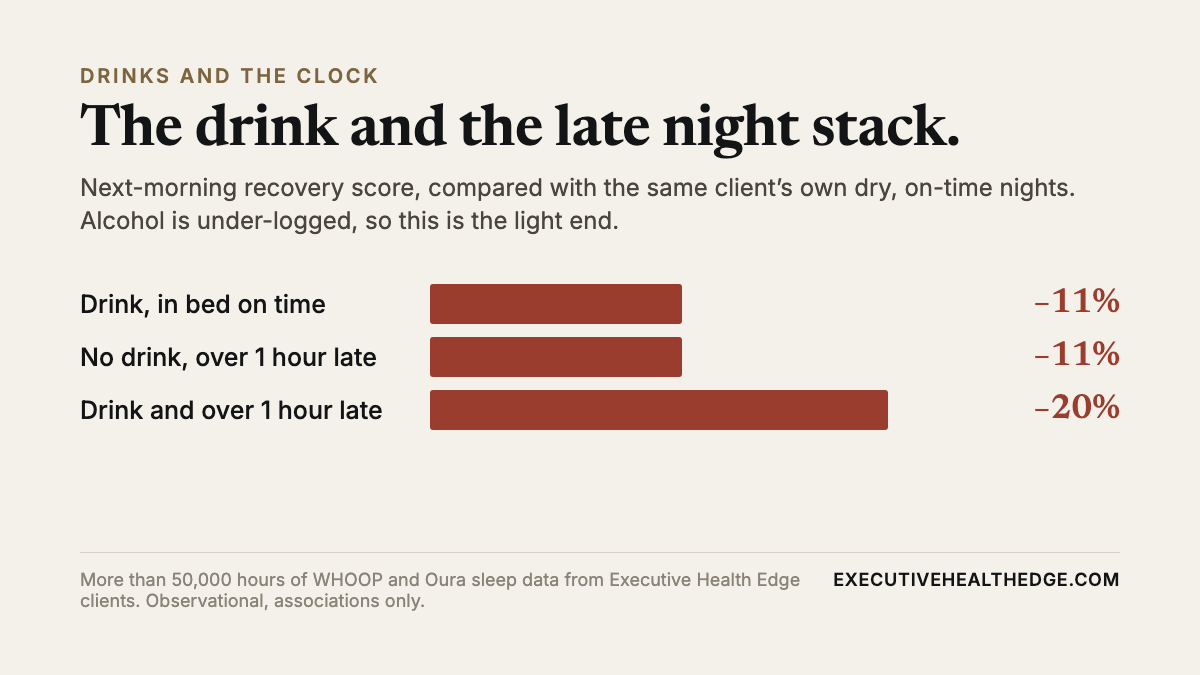 Two drinks with dinner and home on time, the wearable barely notices. The same two drinks at a dinner that runs an hour late show up the next morning.
What it does not show
Bedtime did not predict weight loss directly in this data. It predicts recovery and how much training gets done, and the training is what moves the scale. This is observational coaching data, read as associations, with no control group.
How we hold the standard
The bedtime goes into the plan like a protein target: a number, set on the onboarding call, checked every morning in the recovery data. A late night gets named the same day, before it becomes a late week. On a drinking night, the bedtime does not move. Travel gets its own version, a bedtime in the destination time zone, because the standard does not pause at the airport.
It tells us where to hold the line. The retest tells each client whether it worked.
This page is coaching information, not medical advice. Questions about medication, hormones, or peptides go to the program physician.